


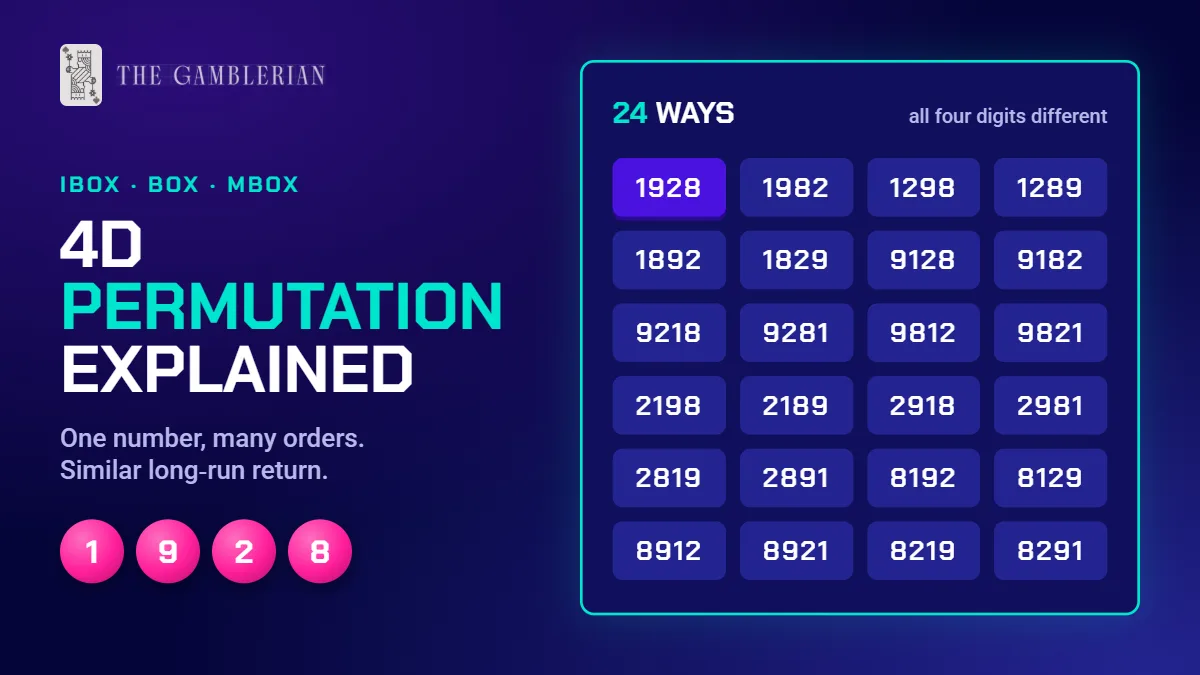
Why does one four-digit number turn into 24 bets, while another turns into only 4? That’s the question behind every 4D permutation, and it’s the part of 4D most people play without ever checking. Box, iBox and mbox bets all rest on the same simple bit of counting. Once you see it, the prize tables stop looking random.
This guide covers what a permutation is, how to count the arrangements of any number, how box and iBox bets differ, and what they really do to your chances. If you’re new to the game itself, start with our guide to 4D odds in Malaysia, which explains the prize structure this one builds on. Nothing here is a system for picking numbers. No such system exists.
4D permutation at a glance
| What it is | The other orders the same four digits can appear in |
| Most arrangements | 24, when all four digits are different (e.g. 1928) |
| Fewest arrangements | 1, when all four digits are the same (e.g. 8888) |
| Box bet | Buys every arrangement at the full stake each, so it costs more |
| iBox bet | Spreads one stake across every arrangement, so each prize is smaller |
| Effect on your odds | You win more often, you win less each time, and the long-run return barely moves |
What is a 4D permutation?
A standard 4D bet is a straight bet. It wins only if your four digits come out in exactly the order you wrote them. If you bet 1928 and the draw produces 9821, a straight bet loses, even though every digit matches.
A permutation is any reordering of those same four digits: 1928, 9821, 2189, 8912 and so on. A permutation bet (sold as box, iBox, mbox or similar, depending on the operator) covers some or all of those orders at once, so a jumbled match still counts.
The digits and the draw don’t change, only what you’ve covered. Our lottery and 4D guide covers the wider family of number games if you want the bigger picture first.
How many permutations does your number have?
It depends on how many digits repeat. Four different digits can be shuffled the most ways. Every repeated digit cuts that number down, because swapping two identical digits produces the same number again.
| Your number’s pattern | Example | Permutations | Name you’ll see |
|---|---|---|---|
| All four digits different | 1928 | 24 | IB24 / 24-way |
| One digit appears twice | 1128 | 12 | IB12 / 12-way |
| Two pairs | 1991 | 6 | IB6 / 6-way |
| One digit appears three times | 1999 | 4 | IB4 / 4-way |
| All four digits the same | 8888 | 1 | No permutation bet possible |
The maths is the factorial rule from school. Four different items can be arranged in 4 × 3 × 2 × 1 = 24 ways. When digits repeat, you divide by the arrangements of the repeats, so 1128 gives 24 ÷ 2 = 12, and 1991 gives 24 ÷ (2 × 2) = 6.
Here’s a fact most guides leave out: across all 10,000 numbers from 0000 to 9999, 5,040 have four different digits and 4,320 have exactly one pair. Only 270 are two pairs, 360 are triples and just 10 are quads. So the 24-way bet is the most common case by far, simply because more numbers fit it.
Box vs iBox: what’s the difference?
Both bets cover every permutation of your number. The difference is how they charge for it.
- Box buys each arrangement as a full bet. A 24-way box on 1928 is 24 straight bets of RM1, so it costs RM24. If one arrangement comes up, you’re paid the normal prize for that RM1.
- iBox spreads a single stake across all the arrangements. RM1 on a 24-way iBox covers all 24 numbers, but each one is effectively backed with about 4 sen, so each prize shrinks to match.
You can see this in Da Ma Cai’s published how-to-play rules for its 1+3D game. A Big iBox on a 24-way number lists a 1st prize of RM105 for RM1. A straight Big RM1 bet pays RM2,500 for the same 1st prize. That’s RM2,500 divided by 24 (about RM104), rounded up. The 12-way table pays RM209 for 1st, the 6-way RM417 and the 4-way RM625, and they follow the same logic.
What about mbox? Names vary between operators and sellers. “iBox”, “mbox”, “i-Perm” and plain “permutation” are all used for spread-stake bets of this kind, but the exact rules and prices are each operator’s own. Read the prize table for the specific product before you buy, and don’t assume a name means the same thing everywhere. Prize tables can also change, so check the current figures on the operator’s own site.
Does iBox improve your odds?
It improves how often you might win and cuts how much you’d win, and the two almost cancel out.
Take the 1st prize on a 24-way number. A straight bet has a 1 in 10,000 chance. An iBox covering all 24 arrangements has 24 in 10,000, about 1 in 417. That looks much better, until you remember that a hit pays RM105 instead of RM2,500.
The fair way to compare is the long-run return per ringgit: add up every prize multiplied by its chance. In our 4D odds guide, a straight Big RM1 bet works out to about 64 sen. Using the Da Ma Cai Big iBox table above:
| Bet (RM1, Big) | Long-run return per RM1 |
|---|---|
| Straight | about 64 sen |
| iBox 24-way | about 67 sen |
| iBox 12-way | about 64 sen |
| iBox 6-way | about 64 sen |
| iBox 4-way | about 64 sen |
The 24-way iBox comes out slightly higher on paper only because its prizes are rounded up (RM2,500 ÷ 24 is RM104.17, paid as RM105). That’s a rounding detail, not an edge. Every option still returns well under a ringgit per ringgit staked over time, and the operator keeps the rest.
The same idea, a built-in return below 100%, is how slot payouts work too, as our explainer on slot RTP and volatility shows. Whatever the game, a different bet type changes how bumpy the ride is. It doesn’t change who comes out ahead in the long run.
Common 4D permutation myths
“Permutation patterns predict the next draw.” You’ll find pages that track how often each arrangement of a number has appeared. They describe the past accurately, but the drum has no memory. 1928 and 9821 are each exactly as likely as any other number in every draw.
“Numbers with four different digits are luckier.” They’re not. They show up more often in results simply because there are more of them (5,040 of 10,000). Any single number, 1928 or 1999 or 8888, still has the same 1 in 10,000 chance.
“A bigger permutation bet is safer.” A 24-way box costs 24 times a straight bet. It covers more numbers, but it’s 24 times the spend, so set your budget by what you can afford to lose, not by how many numbers you want covered.
“This number is due.” A number that hasn’t come out in months isn’t owed a win. It’s the same trap as betting on a colour at the roulette wheel because it hasn’t landed lately.
Before you play any permutation bet
- Count your arrangements first. Know whether your number is 24, 12, 6 or 4-way before you choose box or iBox.
- Read the exact prize table for the product you’re buying. Prizes are per arrangement, and they differ by bet type.
- Check the total cost. A box bet multiplies your stake. An iBox doesn’t, but each prize is smaller.
- Buy from licensed sources only. Malaysia’s licensed 4D operators are separate from the online sites that list “4D-style” games, and our guide to casinos in Malaysia explains what is licensed and what is not.
- Set a budget and stop at it. No permutation bet makes up for chasing losses.
Picking a number without the guesswork
Since every number has the same chance, there’s no wrong way to choose one. If you’d rather not dwell on it, our Feeling Lucky? generator will pick four digits for you. It’s just for fun, and it’s honest about the odds.
The takeaway
A 4D permutation is simple counting: 24 arrangements for four different digits, 12 for one pair, 6 for two pairs, 4 for a triple and 1 for a quad. A box bet buys every arrangement at full price. An iBox shares one stake across them and shrinks each prize to match. Either way you’ll win more often and win less, and the long-run return stays at about 64 sen per ringgit. Choose the bet type by how you like to play, keep the spend within a budget you can afford, and don’t expect any arrangement to beat the drum.